
Motorcycle Helmet Shell Materials: ABS vs Polycarbonate vs Carbon Fiber — What Daily Riders Actually Need

Motorcycle Helmet Shell Materials: ABS vs Polycarbonate vs Carbon Fiber — What Daily Riders Actually Need
Every helmet product page lists a shell material. ABS, polycarbonate, carbon fiber — the names sound technical, but what they actually change for your ride is simpler than most guides make it sound. This article explains the real differences that matter for the way you ride, with no marketing fluff.
A certified ABS helmet protects your head to the same DOT or ECE standard as a carbon fiber helmet. The material does not determine safety — certification does. What the material actually changes is weight, long-ride comfort, and price. For a 25-minute commute, ABS does the job. For all-day touring, carbon fiber's weight savings earn their premium. Match the material to your riding hours, not the marketing.
What Each Shell Material Actually Does
There are three shell materials you will see on product pages, plus fiberglass composite which sits in the middle. Here is the honest version of what each one means — without the spec-sheet filler.
ABS — Affordable, Heavier, Gets the Job Done
ABS (often blended with polycarbonate as a PC/ABS alloy) is injection-molded thermoplastic. It is the most common shell material in entry-level and mid-range helmets because it is affordable to produce and absorbs impact by deforming in a controlled way. The trade-off is weight — ABS helmets are the heaviest of the three, which you notice after about an hour in the saddle. They are also more UV-sensitive over years of sun exposure. For short commutes and around-town riding, ABS is more than enough. DOT and ECE certification are achievable with ABS, and some ABS helmets even pass Snell.
Polycarbonate — The Middle Ground That Most Riders Land On
Polycarbonate offers higher impact and penetration resistance than ABS alone. Helmets with a high-ratio polycarbonate or PC/ABS blend shell sit in the middle of the weight spectrum — noticeably lighter than ABS on a two-hour ride, without the steep price jump of carbon fiber. For a rider who commutes during the week and takes longer weekend rides, polycarbonate often represents the best value point.
Carbon Fiber — Lightest, Priciest, Worth It Only If You Ride Long Enough
Carbon fiber helmets use woven carbon filaments set in resin, often layered with Kevlar or aramid. They are typically 200–400 grams lighter than a comparable ABS helmet. That is about the weight of a half-full water bottle. On a 25-minute commute, you will not feel the difference. After four hours of highway riding with wind buffeting and head checks, you absolutely will. Carbon fiber also disperses impact across a wider area of the EPS liner, which is why it appears in race-oriented and premium touring helmets. But the price is two to three times that of a comparable ABS helmet — and both carry the same DOT sticker.
| Feature | ABS | Polycarbonate | Fiberglass Composite | Carbon Fiber |
|---|---|---|---|---|
| Weight | Heaviest | Moderate | Moderate-light | Lightest |
| Price | $ – $$ | $$ – $$$ | $$$ | $$$ – $$$$ |
| Impact Style | Localized deformation | Moderate spread | Good dispersion | Wide-area dispersion |
| DOT / ECE Capable | Yes | Yes | Yes | Yes |
| Snell Capable | Yes (some models) | Yes (some models) | Yes | Yes |

Three Riders, Three Material Choices
Instead of treating shell material as a spec-sheet hierarchy, it is more useful to look at how real riders with different routines experience the differences. Here are three common profiles.
Jake — 25 Minutes Each Way
Jake commutes across town five days a week, 25 minutes each way, plus occasional weekend errands. He spends maybe five hours a week in the helmet. He bought an ABS helmet two years ago, it fits well, and he has never once thought about the weight. For Jake, spending more on carbon fiber would be money wasted — he would not feel the grams on a 25-minute ride. What he should focus on instead: a clear visor with good peripheral vision, a removable washable liner, and checking the five-year replacement date.
Sarah — 2–4 Hour Canyon Runs
Sarah commutes 30 minutes to work but lives for Saturday canyon rides that stretch two to four hours at highway speeds. After her first season with an ABS helmet, she noticed her neck was stiff by the third hour. She switched to a fiberglass composite helmet and the difference was noticeable — not dramatic, but enough that she stopped thinking about her neck and started enjoying the last hour of the ride. For Sarah, a polycarbonate or fiberglass shell hit the sweet spot: real weight savings without the carbon fiber price tag.
Mike — 6–8 Hour Days, Multi-Day Trips
Mike tours. Long weekends, multi-state trips, six to eight hours in the saddle per day. He started with a polycarbonate helmet and upgraded to carbon fiber after his first season. The roughly 300-gram difference became meaningful around hour four of every riding day — less neck fatigue, easier head checks, less overall physical drain by the time he pulled into camp. For Mike, the carbon fiber premium was not about spec sheets or bragging rights. It was about arriving less tired, day after day.

A quick self-check: after your next ride, notice what you do first when you take the helmet off. If you roll your neck or feel the weight lift off your head, a lighter shell material is worth exploring. If you feel fine, spend your budget on fit and certification instead.
Why Certification Matters More Than the Material Name
This is the section that separates marketing from reality. A helmet's safety is determined by how the complete system — shell, EPS liner, retention strap, visor — performs in standardized impact tests, not by what the shell is made of.
In the United States, DOT FMVSS 218 is the federal minimum. Manufacturers self-certify their helmets and NHTSA conducts random compliance spot-checks. The tests cover impact attenuation at multiple anvil shapes, penetration resistance, and retention system strength. NHTSA motorcycle helmet safety guidance outlines the requirements — and the standard is material-agnostic. An ABS helmet and a carbon fiber helmet must meet the same thresholds.
ECE 22.06 is the current European standard and widely considered more comprehensive than DOT. It requires independent third-party testing at random impact points, includes rotational acceleration measurements, and tests visors and chin bars. ECE 22.06 is mandatory for helmets sold in over 50 countries. If a helmet carries both DOT and ECE 22.06, it has been evaluated more thoroughly than DOT alone requires.
Snell M2025 is a voluntary independent standard with stricter G-force limits than DOT, chin bar impact testing for full-face helmets, and random retail sample testing. Snell helmet standards information explains the testing protocol. ABS helmets can and do earn Snell certification — the material is not the limiting factor.
- Look for the certification sticker inside the helmet — not the one printed on the box.
- DOT + ECE 22.06 dual-certified means the helmet has been independently lab-tested.
- A certified helmet that fits poorly cannot protect you as designed — fit comes before material.
- Inspect that the EPS liner shows no gaps, cracks, or separations before buying.

How the Shell and EPS Liner Work Together
In an impact, the outer shell hits first — distributing force across the EPS liner, resisting penetration, and providing abrasion resistance during a slide. The EPS liner underneath crushes permanently, converting kinetic energy into material deformation and buying your brain milliseconds to decelerate. This is why helmets are single-use for significant impacts: the crushed EPS cannot recover, even if the outer shell looks fine.
What changes by material is how force reaches the EPS. Carbon fiber spreads impact across a wider foam section. ABS concentrates it more locally. Both approaches keep G-forces below the injury threshold in a certified helmet — they just take different engineering paths to get there. The practical takeaway: replace any helmet after a real hit, regardless of shell material. The invisible damage is in the EPS, not the shell.

How to Apply This When Choosing a Helmet
If you are shopping for a helmet and trying to apply what you just read, here is the practical version. Instead of picking a material first, pick the riding profile that matches you — then look at helmets that fit that profile. The material follows the need, not the other way around.
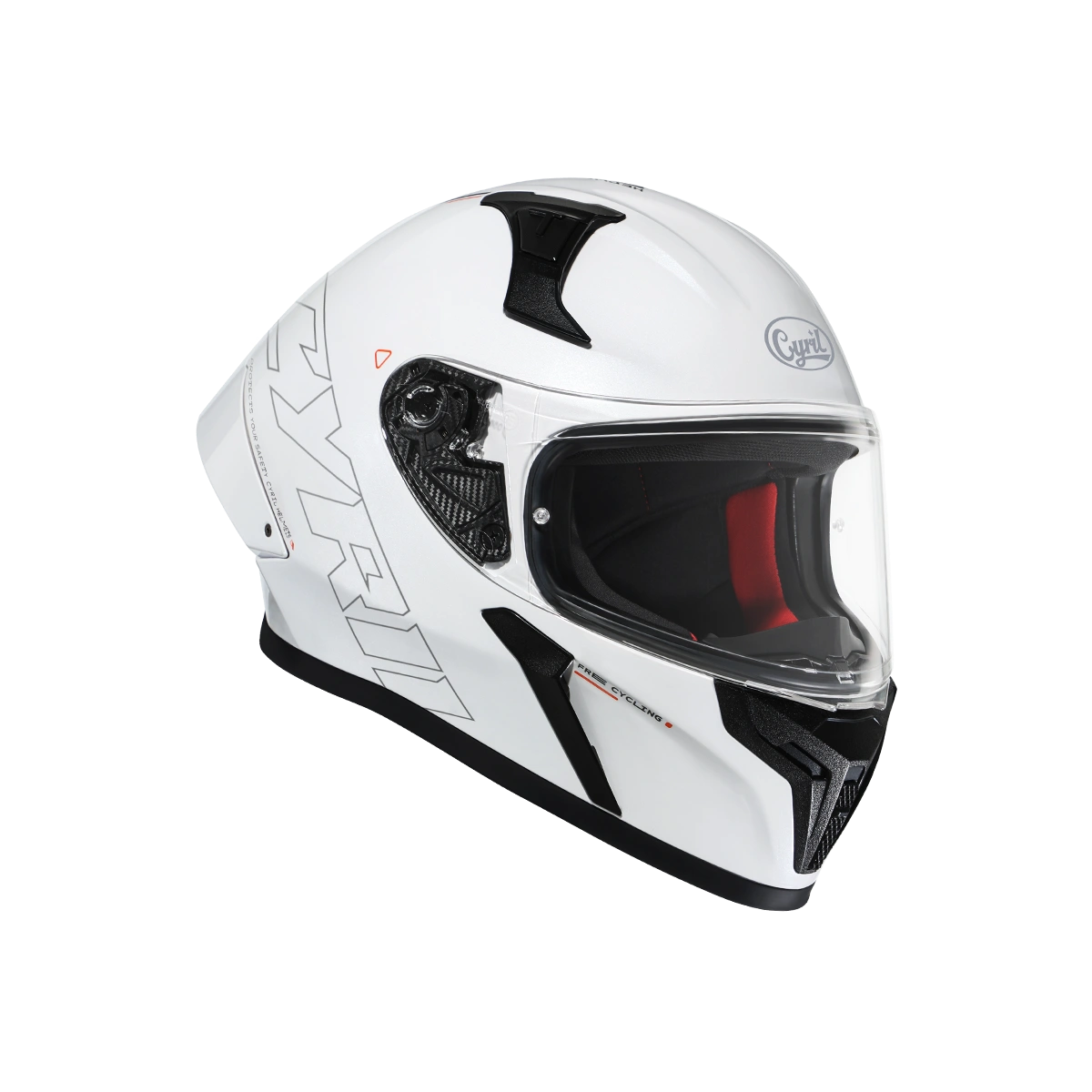
Best for Daily Commuters
The Mad Shark Full Face Helmet uses an ABS shell with multi-layer EPS and active ventilation — the material-and-value combination that works for riders like Jake. DOT-certified, clear visor, removable washable liner. If your week is commuting and errands, this is the practical choice.
View Mad Shark
Best for Mixed Riding
The R1-PRO Full Face Helmet suits riders like Sarah — weekday commutes plus weekend rides that stretch past two hours. Sport-inspired profile, magnetic visor release, active ventilation, DOT FMVSS 218 and ECE 22.06 certified. The lighter shell and refined feature set become more noticeable the longer your rides get.
View R1-PRO
Best for Touring and Long Rides
The A128 Dual Visor Modular Helmet fits riders like Mike who spend long days in the saddle. Dual visor convenience, flip-up modular design for frequent stops, DOT FMVSS 218 and ECE 22.06 certified, wide-view comfort, removable washable liner. For multi-hour riding days where every feature earns its place.
View A128The shell material is one variable in a system. A certified ABS helmet that fits and gets worn every ride protects you. A carbon fiber helmet that sits on the shelf because it does not fit comfortably does not. Choose the helmet you will actually wear — with the fit, certification, and weight that match your riding week.
Common Questions About Helmet Shell Materials
Are carbon fiber motorcycle helmets worth the extra money?
Only if you regularly ride for more than two hours at a time. The 200–400 grams of weight savings over ABS become meaningful on long rides — less neck fatigue, easier head checks, less physical drain. For a 25-minute commute, you will not feel the difference, and the money is better spent on fit, a second visor, or quality earplugs.
Do carbon fiber helmets crack more easily than ABS helmets?
No — carbon fiber is actually stronger per weight than ABS. However, carbon fiber can crack rather than deform on very sharp point impacts where ABS might dent. Both behaviors are by design: the shell is meant to manage energy, not survive pristine. A cracked carbon fiber shell after a significant impact did its job, just like a deformed ABS shell did. Either way, replace the helmet.
What is the lifespan of a carbon fiber helmet vs ABS?
The standard five-year replacement guideline from the manufacturing date applies to all shell materials. Carbon fiber and fiberglass are more UV-resistant than ABS, which can become brittle after years of direct sun. But the EPS liner, comfort padding, and adhesives degrade on a similar timeline regardless of shell type. Sweat, vibration, and temperature cycles age the inside of the helmet faster than UV ages the outside.
Is polycarbonate better than ABS for motorcycle helmets?
Polycarbonate has higher impact and penetration resistance than ABS alone, and polycarbonate shells are typically lighter. For a rider doing mixed commuting and weekend leisure riding, polycarbonate offers a real upgrade in comfort without the carbon fiber price jump. For short commutes only, ABS is sufficient — the difference will not be noticeable on a 20-minute ride.
Why do racing helmets often use carbon fiber shells?
Three reasons: weight, weight, and weight. At race speeds, every gram of helmet mass increases rotational inertia during head checks and adds neck fatigue over a race distance. Carbon fiber also spreads impact across a wider EPS area — useful at the higher impact speeds seen on track. For street riders, the same physics apply, just at lower stakes: a lighter helmet is more comfortable, not necessarily safer.
Can an ABS helmet be as safe as a carbon fiber helmet?
Yes. Both can pass DOT, ECE 22.06, and Snell certification. The standard measures the complete helmet system — the test does not care what the shell is made of, only whether peak G-forces and penetration stay below the threshold. An ABS helmet that fits your head shape correctly will protect you better than a carbon fiber helmet that does not fit.
How much weight can a carbon fiber helmet actually save?
Typically 200–400 grams (7–14 ounces) compared to a same-size ABS helmet. That is about the weight of a half-full water bottle or a smartphone. It sounds small, but the difference accumulates: after four hours of highway riding, the reduced neck fatigue is noticeable. For a 25-minute commute, you will not feel it.
Does shell material affect wind noise?
Indirectly. Carbon fiber and composite shells tend to dampen vibration better than ABS, which can slightly reduce transmitted wind noise. However, fit, visor seal, helmet shape, and neck roll design affect noise far more than shell material. Do not buy a carbon fiber helmet expecting quiet — buy it for the weight. Wear earplugs regardless of material for any sustained highway riding.
Final Notes
Motorcycle helmet marketing makes shell material sound like a clean upgrade path — ABS is basic, carbon fiber is premium. The reality is more practical. The material is one variable in a system that includes fit, certification, ventilation, and visor quality. A certified ABS helmet that fits and gets worn every ride protects you. A carbon fiber helmet that does not fit does not.
For short commutes, buy for fit and certification. For mixed riding, a polycarbonate or fiberglass shell balances weight and cost. For all-day touring, carbon fiber earns its premium. Match the material to your riding hours, not the product page hierarchy.